
PoSH Act 2013: 8 Common Myths About Workplace Sexual Harassment in India (2026 Guide)
It began with a “harmless” joke in the office group chat, something that made everyone laugh without giving it a second thought. Then came the late-night messages, allegedly “work-related” in nature, but never quite necessary. When she finally spoke up, the response came quickly: “You’re overreacting. This isn’t harassment.”
This reaction is far too common in Indian workplaces today. It reveals a larger problem that goes beyond individual behavior and points to a systemic lack of awareness. Despite the strict mandates of the Sexual Harassment of Women at Workplace (Prevention, Prohibition and Redressal) Act, 2013 (PoSH Act), countless incidents go unreported. This happens not because the law lacks teeth, but because these situations are misunderstood, laughed off, or dismissed as casual banter.
The real problem isn’t just the harassment itself—it’s the myths we believe about it. These widely accepted misconceptions dilute the law, dissuade employees from speaking up, and expose organizations to severe legal and reputational risks.
It is time to clear the confusion. Let’s separate fact from fiction and bust eight major myths about the PoSH Act that every employer and employee in India needs to understand.
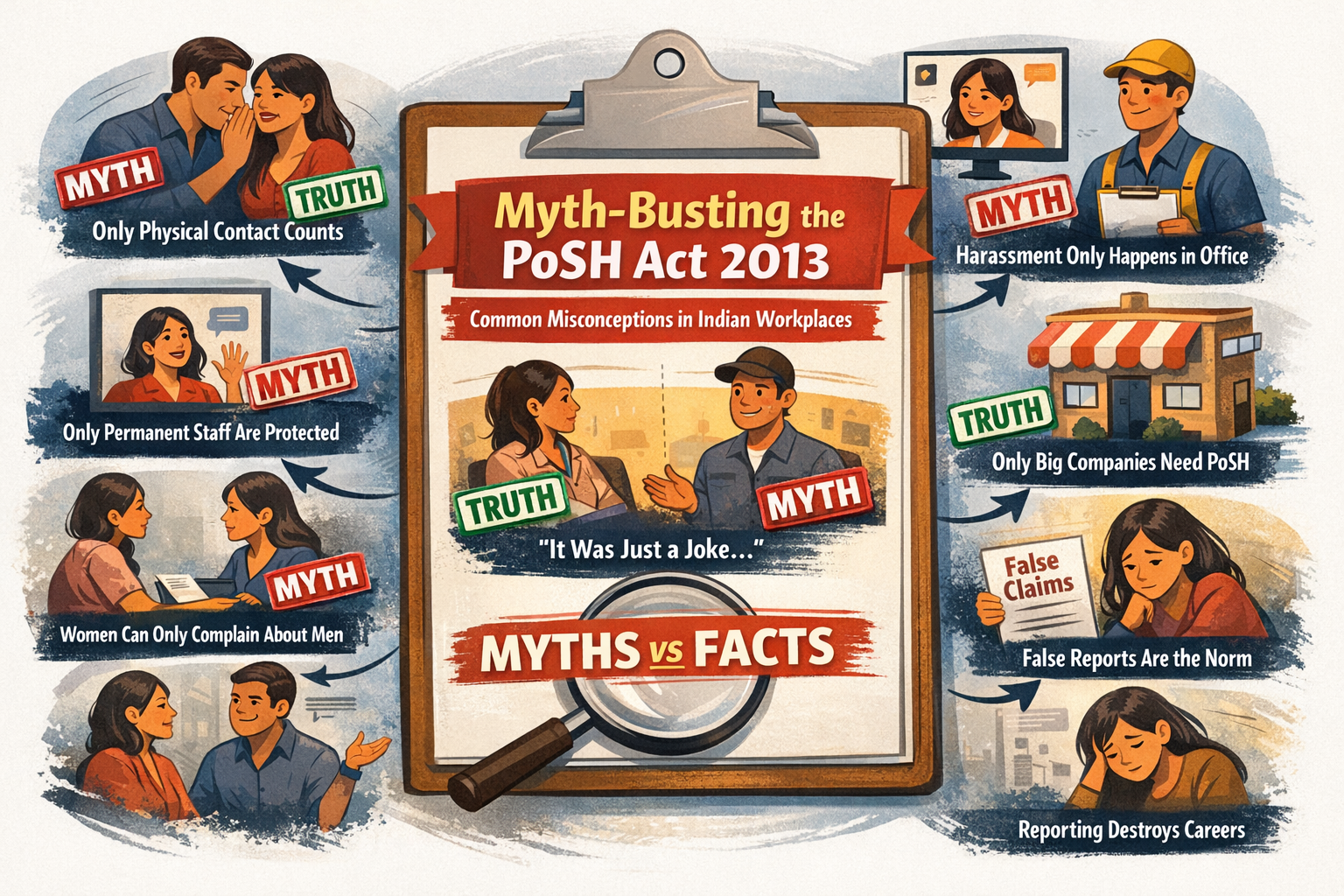
Myth 1: Only Physical Contact Amounts to Sexual Harassment
A dangerous misconception surrounding workplace sexual harassment is that it must involve physical touch to be actionable. People frequently dismiss inappropriate comments, text messages, or jokes as “just office banter.” In reality, the PoSH Act adopts a much broader definition.
The law clearly outlines that sexual harassment includes verbal, non-verbal, and digital behavior. Sexually coloured remarks, inappropriate jokes, demands for sexual favours, or suggestive gestures all create a hostile work environment. Ultimately, the law focuses on unwelcome behavior that violates the dignity of a woman, regardless of whether a hand was ever laid on her.
Myth 2: Harassment Is Confined to the Office Building
With the rapid evolution of hybrid and remote work models across India, sexual harassment is no longer confined to the four walls of a physical office. The PoSH Act acknowledges this reality through the concept of the “extended workplace.”
The law’s scope extends to any place visited by the employee arising out of or during the course of employment. This includes virtual meetings, company-provided cabs, offsite team lunches, and digital platforms like WhatsApp or Slack. Sexual harassment in an email or over a Zoom call carries the exact same legal weight as harassment in the corporate boardroom.
Myth 3: Only Permanent Employees Are Protected
Many organizations mistakenly assume that the PoSH Act only protects full-time, permanent employees on the company payroll. This myth makes it dangerously easy to ignore the experiences of vulnerable workers.
Under Section 2(f) of the PoSH Act, the definition of an “employee” is remarkably wide. It covers interns, trainees, part-time staff, ad-hoc workers, volunteers, and even domestic workers. Furthermore, women visiting the workplace—such as clients, vendors, or interview candidates—are also protected. The law emphasizes safety for any woman interacting with your workplace setting, completely regardless of her employment status or contract type.
Myth 4: Only Large Corporations Need to Comply
A widespread belief among startups and SMEs is that only massive corporations are required to enforce PoSH policies. This “small means safe” mentality leads to non-compliance, lack of sensitization training, and the absence of an Internal Committee (IC)—the exact conditions under which sexual harassment thrives.
The law applies to all workplaces in India, irrespective of their scale or revenue. Any organization with 10 or more employees must legally constitute an Internal Committee. Establishments with fewer than 10 employees are still bound by the law; their complaints simply fall under the jurisdiction of the Local Committee (LC) established at the district level.
Myth 5: PoSH Complaints Can Only Be Lodged Against Men
Because the PoSH Act is gender-specific in its protection—designed explicitly to protect women as the “aggrieved persons”—many assume the harasser must be a man. However, the legislation does not restrict the identity of the respondent to any particular gender.
A woman can face sexual harassment from another woman, and the PoSH Act fully applies to such situations. Additionally, while the statutory law explicitly focuses on harassment faced by women, forward-thinking companies implement gender-neutral or gender inclusive anti-harassment policies and another Committee to protect all employees inclusive of LGBTQ+ individuals and men.
Myth 6: If There Is No Malicious Intent, It Is Not Harassment
Countless respondents hide behind the defense of “I was just joking” or “I didn’t mean to make her uncomfortable.” Under the PoSH Act, the intent behind the action is entirely secondary.
The law operates on the principle of impact over intent. What may be perceived as a harmless joke or friendly gesture by one person can be deeply offensive and unwelcome to another. If the conduct is of a sexual nature and is unwelcome to the recipient, it constitutes sexual harassment.
Myth 7: False Complaints Are Easy to File Without Consequences
A persistent fear among leadership is that the PoSH Act will be weaponized by employees filing false complaints to settle personal scores. To balance the scales of justice, Section 14 of the Act contains strict safeguards against malicious intent.
If an Internal Committee concludes that a complaint was entirely false and made with malicious intent, strict disciplinary action can be taken against the complainant. However, the law draws a very fine line: mere inability to provide adequate proof does not automatically make a complaint false or malicious. This ensures that the genuine aggrieved are not terrified of coming forward.
Myth 8: Reporting Will Ruin the Aggrieved’s Career
The biggest barrier to reporting workplace harassment in India is the fear of impact on one’s profession. Employees often suffer in silence because they fear retaliation, demotion, or being permanently labeled as a “difficult” hire in their industry.
To combat this, the PoSH Act legally mandates strict confidentiality during and after the inquiry process. Employers are also obligated to provide protection against retaliation. If an aggrieved woman requests it, the IC can even recommend interim relief, such as transferring her or the respondent to a different department while the investigation is ongoing.
Building a Truly Safe Workplace
Workplace sexual harassment today is often subtle, hiding behind humor, informality, or digital screens. However, what makes it truly difficult to eradicate are the misconceptions surrounding the law.
By actively breaking these myths through continuous employee sensitization, we move closer to workplaces that are not only legally compliant but genuinely respectful. Regardless of whether it occurs in a physical meeting room or a virtual space, one principle must remain constant for your business: Respect is not optional, it is a right.