
The Departmental Inquiry Trap: Why Bypassing The IC is Legally Void Under the PoSH Act
TL;DR
- The Core Mistake: HR teams and leadership frequently route workplace sexual harassment complaints into parallel departmental inquiries or hire independent external investigators to resolve matters quickly.
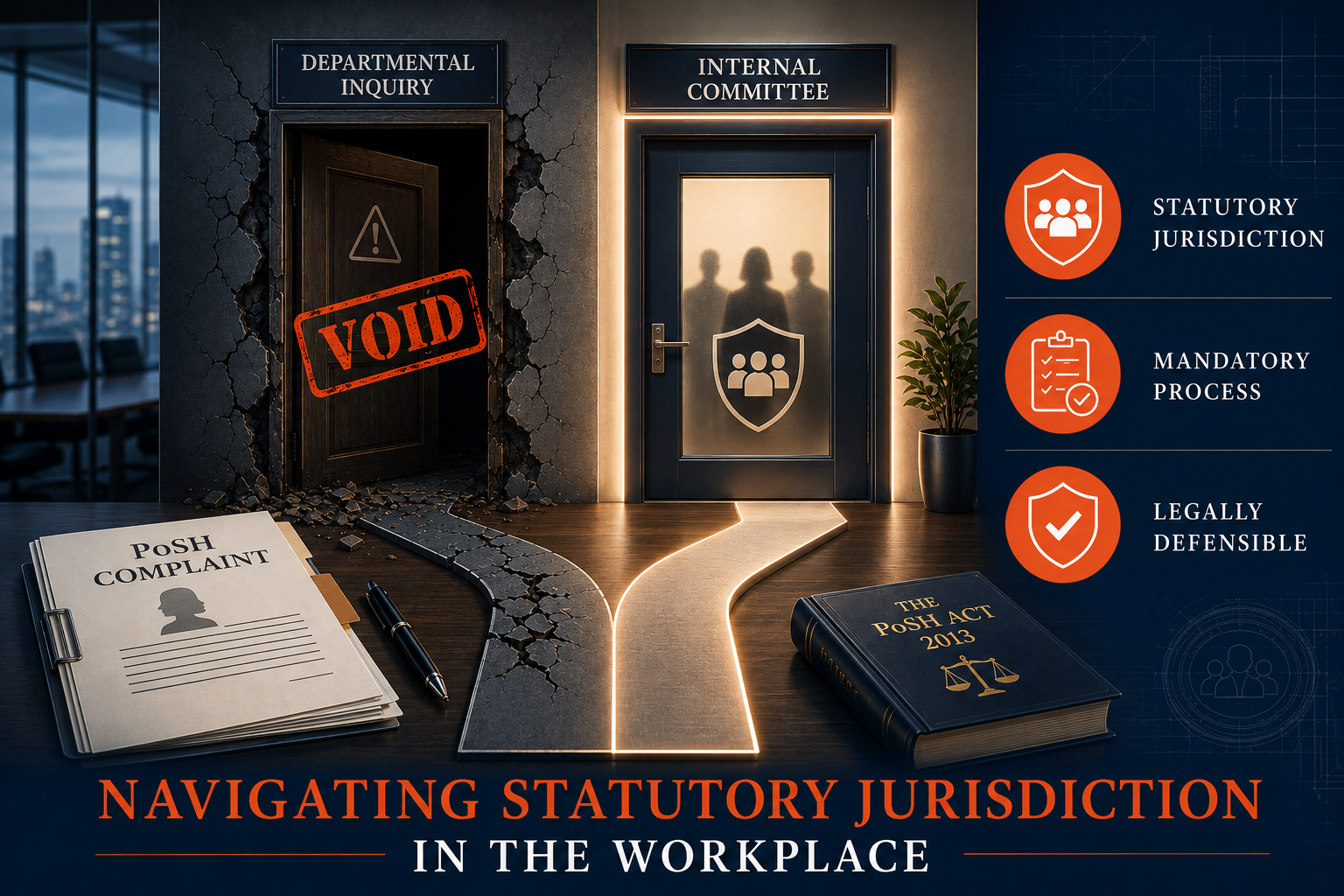
- The Legal Reality: Under the PoSH Act, 2013, the Internal Committee (IC) has exclusive statutory jurisdiction. Bypassing it renders the entire investigation and any subsequent disciplinary actions legally void.
- The Judicial Precedent: The Madhya Pradesh High Court (May 2026) quashed a university professor’s termination because the employer bypassed its IC and relied on an inquiry conducted by a retired judge.
- The Takeaway: Your zero-tolerance policy means nothing without strict procedural compliance. All workplace sexual harassment complaints must go exclusively to the IC/LC.
When a sexual harassment complaint is made, the instinct in many organisation is often the same: act fast, look decisive, and “fix” the situation before it escalates. In that rush, organizations commit one quiet but fatal mistake—routing the complaint into a departmental inquiry or appointing an independent external inquiry officer, instead of sending it to the Internal Committee (IC) mandated under the Sexual Harassment of Women at Workplace (Prevention, Prohibition and Redressal) Act, 2013, (“PoSH Act”).
On the surface, it sounds like best practice: “Let’s get a retired judge or a senior external expert to run a watertight inquiry.” In reality, it is against the law.
Under the PoSH Act, the IC is not an optional forum, it is the exclusive statutory authority to inquire into workplace sexual harassment complaints. Any parallel departmental inquiry outside this mechanism is legally void, and any order based on it is vulnerable to being struck down in court. A recent judgment of the Madhya Pradesh High Court illustrates this risk with absolute clarity.
The MP High Court Case: What Went Wrong
In Dr. Sajan Kurien Mathew v. The State of Madhya Pradesh and Others (Writ Petition No. 1662 of 2026) the High Court of Madhya Pradesh at Gwalior was asked to decide whether a university could rely on a departmental inquiry, conducted by an independent inquiry officer to dismiss a professor accused of sexual harassment by students.
The facts, in simple terms
- Female students of a university complained of serious sexual harassment by an assistant professor, including inappropriate physical contact and conduct inside the studio and examination settings.
- An FIR was also registered against the professor under the Bharatiya Nyaya Sanhita (BNS), leading to parallel criminal proceedings.
- Instead of channeling the complaint to the IC, the university initiated departmental proceedings and appointed a retired Principal District Judge as an independent inquiry officer to examine the allegations.
- The inquiry officer held the charges proved and recommended dismissal. The university terminated the professor’s services by an order dated December 31, 2025, relying entirely on this departmental inquiry report.
- The professor challenged his dismissal before the High Court, arguing that once allegations amount to sexual harassment at the workplace, only the IC can conduct the inquiry under the PoSH Act and applicable service rules.
What the Madhya Pradesh High Court Held
On May 15, 2026, the Madhya Pradesh High Court categorically rejected the university’s approach. Justice Ashish Shroti held that:
- Complaints of workplace sexual harassment must be investigated only by the IC/LC constituted under the PoSH Act and relevant service rules.
- The disciplinary authority is “denuded of power” to appoint any parallel independent inquiry officer once the allegations fall within the ambit of sexual harassment under the PoSH framework.
- The departmental inquiry conducted by the retired judge was legally incompetent to substitute the IC/LC, and the termination order based on that inquiry was therefore unsustainable.
The Operative Directions
The Court:
- Quashed the termination order dated December 31, 2025.
- Directed the university to forward the complaint to the appropriate IC/LC and ensure that the inquiry is conducted strictly in line with the PoSH Act and relevant service rules.
- Ordered reinstatement of the professor pending the outcome of the proper IC/LC inquiry and permitted him to join at his transferred posting.
For employers, the message is unambiguous: if you bypass your IC in PoSH matters, even with the best of intentions your entire disciplinary process is exposed to being overturned.
Why the IC’s Jurisdiction Is Exclusive
The PoSH framework is deliberately designed around specialized internal bodies, the IC/ LC to balance legal rigor with psychological safety. They are not just “another committee”; they are the only committees legally empowered to investigate sexual harassment complaints at the workplace.
Key design features of the IC
- Mandatory statutory composition: Section 4 of the PoSH Act requires that the IC be chaired by a senior woman employee and include members preferably committed to the cause of women or who have had experience in social work or have legal knowledge, alongside an external member from an NGO or association committed to women’s causes. This structure ensures sensitivity, contextual understanding, and independence of the IC.
- Specialized capacity building: While generic inquiries focus often on punitive corporate misconduct, IC members are specifically trained in trauma-informed interviewing, evaluating evidence under civil probabilities, and managing strict statutory timelines. This ensures a highly specialized, gender-sensitive lens that standard ad-hoc or departmental panels completely lack.
- Confidentiality under Section 16: Identities, complaint contents, and proceedings are shielded from publication or disclosure, with strict penalties for breach. ICs function within this statutory confidentiality matrix, while ad hoc corporate bodies often lack clear confidentiality protocols.
In short: your IC is not just a formal requirement—it is the legal spine of your PoSH architecture. If you route complaints anywhere else, the entire body collapses.
The Departmental Inquiry Trap: Risks for Organizations
The Dr. Sajan Kurien Mathew judgment is more than a one‑off academic case; it’s a cautionary tale for every HR and legal team that tries to “strengthen” PoSH proceedings by layering in an external inquiry mechanism.
The Hidden Risks of Bypassing The IC
- Nullification of disciplinary action: Any dismissal, suspension, or adverse service consequence based on a non‑IC inquiry is vulnerable to being struck down by courts or tribunals, as seen in the MP High Court ruling.
- Procedural non‑compliance penalties: Non‑adherence to PoSH procedures, including failure to route complaints to the IC/LC can attract reputational damage, and regulatory scrutiny.
- Reputational fallout: A reinstatement order after a high‑profile dismissal sends a damaging message to employees and markets about the organization’s grasp of PoSH law compliance.
- Erosion of complainant trust: When complainants see their cases pushed into opaque, non‑specialized processes, their confidence in the system, and willingness to report is severely undermined.
Your “zero‑tolerance” policy is only as strong as the procedural path you choose. If that path sidesteps the IC, zero tolerance becomes zero defensibility.
What HR and Leadership Must Do Differently
The clear takeaway from the MP High Court’s ruling is that PoSH law complaints demand a dedicated, statutory route—not improvisation. For HR heads, CHROs, in‑house counsel, and compliance leaders, that translates into a few non‑negotiable actions:
- Route sexual harassment complaints only to the IC.
Build internal SOPs that explicitly bar departmental inquiries, vigilance panels, or “special committees” from handling PoSH law complaints. - Empower the IC, don’t overshadow it.
Ensure IC members are trained, supported, and trusted to handle complex, sensitive matters, from evidence evaluation to report writing, without being second‑guessed by parallel bodies. - Align service rules with PoSH.
Review your standing orders, HR manuals, and disciplinary rules to ensure they point directly to the IC for sexual harassment inquiries and mirror the mandatory procedural steps recognized by courts. - Educate leadership and line managers.
Senior stakeholders must understand that “calling in an external inquiry officer” does not strengthen the case, it may legally collapse it.
How Rainmaker Helps You Stay PoSH‑Strong
At Rainmaker, we see this judgment as a moment of reckoning for workplace compliance: intent is not enough; procedure is everything. Our solutions are built to ensure that your IC, your policies, and your people operate in lockstep with the PoSH framework and recent judicial developments.
Do not let well‑intentioned administrative shortcuts turn your PoSH framework into a legal vulnerability. If a complaint involves sexual harassment at the workplace, there is only one lawful destination: your IC.
Suggested Reading
- The Boundaries of PoSH: Why an Internal Committee Cannot Punish General Misconduct
- Supreme Court Clarifies Internal Committee (IC) Jurisdiction Under the PoSH Act: A Landmark Ruling for Women at Work
- PoSH Act Investigations India 2025: Balancing Impact and Intent in Sexual Harassment Cases
- Members of IC to be treated at par with Judges
- Mastering Workplace Compliance: A Comprehensive Guide for Employers on PoSH Regulations