
The Architecture of Risk: Why the GCC’s Fragmented Compliance House is Collapsing in 2026
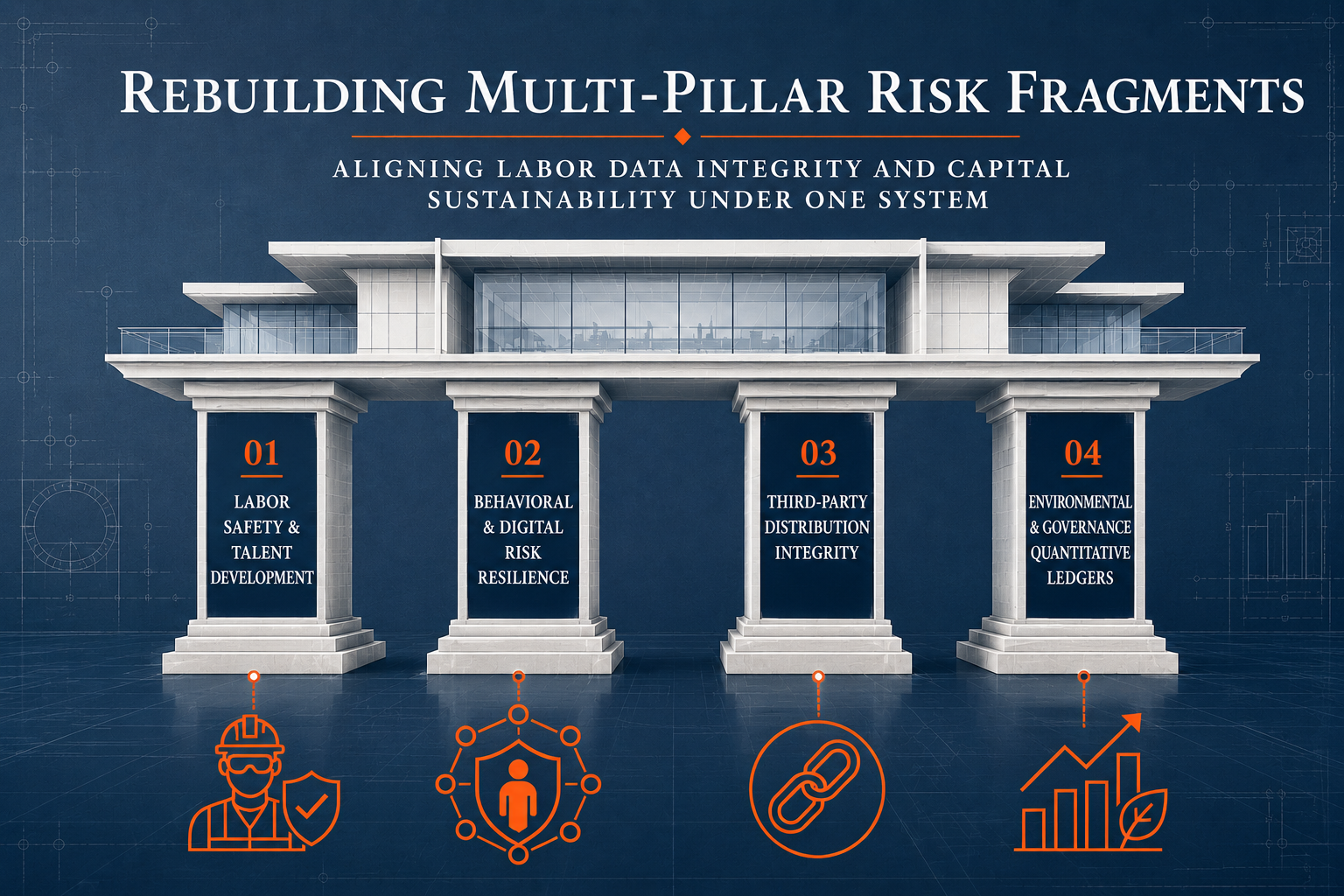
If you sit in on a board meeting at a major conglomerate in Riyadh or Dubai this month, you will likely witness a very specific type of corporate anxiety. The Chief Human Resources Officer, the Chief Information Security Officer, the Head of Legal, and the Sustainability Director are all staring at the same regulatory mandates, yet they are trying to solve them in total isolation.
For the past decade, GCC organizations treated compliance like a series of disconnected rooms. HR handled labor quotas. IT managed firewalls. Legal drafted vendor contracts. Sustainability wrote the glossy annual report.
But in 2026, the walls between those rooms have disappeared.
The regulatory environment across the Gulf Cooperation Council has matured at an unprecedented velocity. As governments push toward aggressive economic diversification under frameworks like Saudi Vision 2030 and “We the UAE 2031”, the boundaries between human resources, legal liability, and capital market reporting have effectively vanished. You can no longer separate how you treat your people from how you protect your data, nor can you isolate your supply chain ethics from your ESG valuation.
It is all one ecosystem. And organizations that fail to connect these dots are finding that their entire governance structure is fundamentally unstable. To survive 2026, corporate leaders must reinforce four interconnected pillars of compliance.
Pillar 1: The Localization and Labor Trap
Nationalization programs are no longer a simple headcount exercise. In the UAE, the Nafis program heavily penalizes companies failing to meet Emiratisation targets. In Saudi Arabia, the Ministry of Human Resources and Social Development is enforcing strict Saudization quotas across specific professions.
However, the overlooked spot for most GCC employers is retention. Companies are paying a premium to recruit local talent, only to lose them six months later to a toxic workplace or a lack of psychological safety. Compliance here is not just about filing recruitment numbers. It requires building a localized, respectful workplace culture where grievance mechanisms actually work. If an organization lacks digital records proving it actively trains its workforce on workplace respect and anti-harassment, it is failing the new standard of labor compliance.
Pillar 2: Data Privacy as a Behavioral Crisis
With the strict enforcement of the UAE Personal Data Protection Law (PDPL) and Saudi Arabia’s updated data protection frameworks, the penalties for mishandling sensitive information are severe. Yet, boards continue to treat cybersecurity and data privacy as a technology problem to be solved by the IT department.
The reality is stark. As noted in major global risk analyses, the vast majority of cybersecurity breaches stem from human error. The most expensive zero-trust architecture in the world cannot stop an exhausted, stressed employee from clicking a sophisticated phishing link. True compliance in 2026 requires behavioral cyber resilience. This means deploying scenario-based training that teaches employees how to manage data safely under intense deadline pressure, transforming them from a systemic vulnerability into an active human firewall.
Pillar 3: The Supply Chain Infection
Anti-Bribery and Anti-Corruption (ABAC) scrutiny has shifted dramatically. Regulators are no longer just looking at the actions of your internal executives; they are looking at your third-party vendors.
If a logistics contractor in your supply chain violates ethical standards, the regulatory liability flows directly upstream to your boardroom. Managing this third-party due diligence is nearly impossible if you rely on static, PDF-based vendor codes of conduct. Organizations are now legally required to prove that their external partners comprehend and abide by their ethical standards. This requires scalable, digital ethics training that captures verifiable comprehension scores and policy attestations across the entire supply chain.
Pillar 4: The ESG Ledger
What began as voluntary corporate social responsibility has mutated into hard, mandatory financial reporting. Regional capital markets, guided by frameworks like the Saudi Exchange (Tadawul) ESG Disclosure Guidelines and ADX mandates, now demand quantitative evidence of social and governance practices.
This is where the siloed approach entirely breaks down. Sustainability officers cannot publish a credible ESG report if the data they need is trapped inside HR and Legal software. When an organization conducts a diversity workshop or an ABAC refresher, that is not just an internal HR activity. It is hard “Governance” and “Social” data that must be mapped directly to global reporting standards to attract foreign capital.
Rebuilding the Corporate House
These four pillars cannot stand independently. They require a unifying architecture, and that architecture is culture.
A defensible, compliant organization is not built by dispatching four different legal memos from four different departments. It is built through a unified, culturally intelligent learning strategy. This is the exact infrastructure Rainmaker provides for the Middle East market.
We replace fragmented, globally recycled compliance videos with a comprehensive library of dramatized e-modules designed specifically for GCC workplace dynamics. Hosted natively on our RMEXP Learning Management System or licensed seamlessly to your own platform, we ensure that every employee and vendor receives consistent, engaging training across Labour, Data, Integrity, and ESG risks.
We help boards move beyond simply ticking boxes. We generate the audit-ready behavioral data that proves your compliance house is built on a foundation of measurable integrity.
The question for GCC boards in 2026 is simple: Which pillar of your organization is the strongest today, and which one is actively threatening the rest of the structure?
🌍 Explore Integrated Culture & Compliance Solutions: https://rainmaker.co.in/culture-learning-solutions-for-middle-east/
📞 Speak to our GCC Strategists: +91 90290 00180
📧 Contact us: [email protected]