
The Q3 Compliance Cliff: Why Your GCC Culture is Dying on the Vine
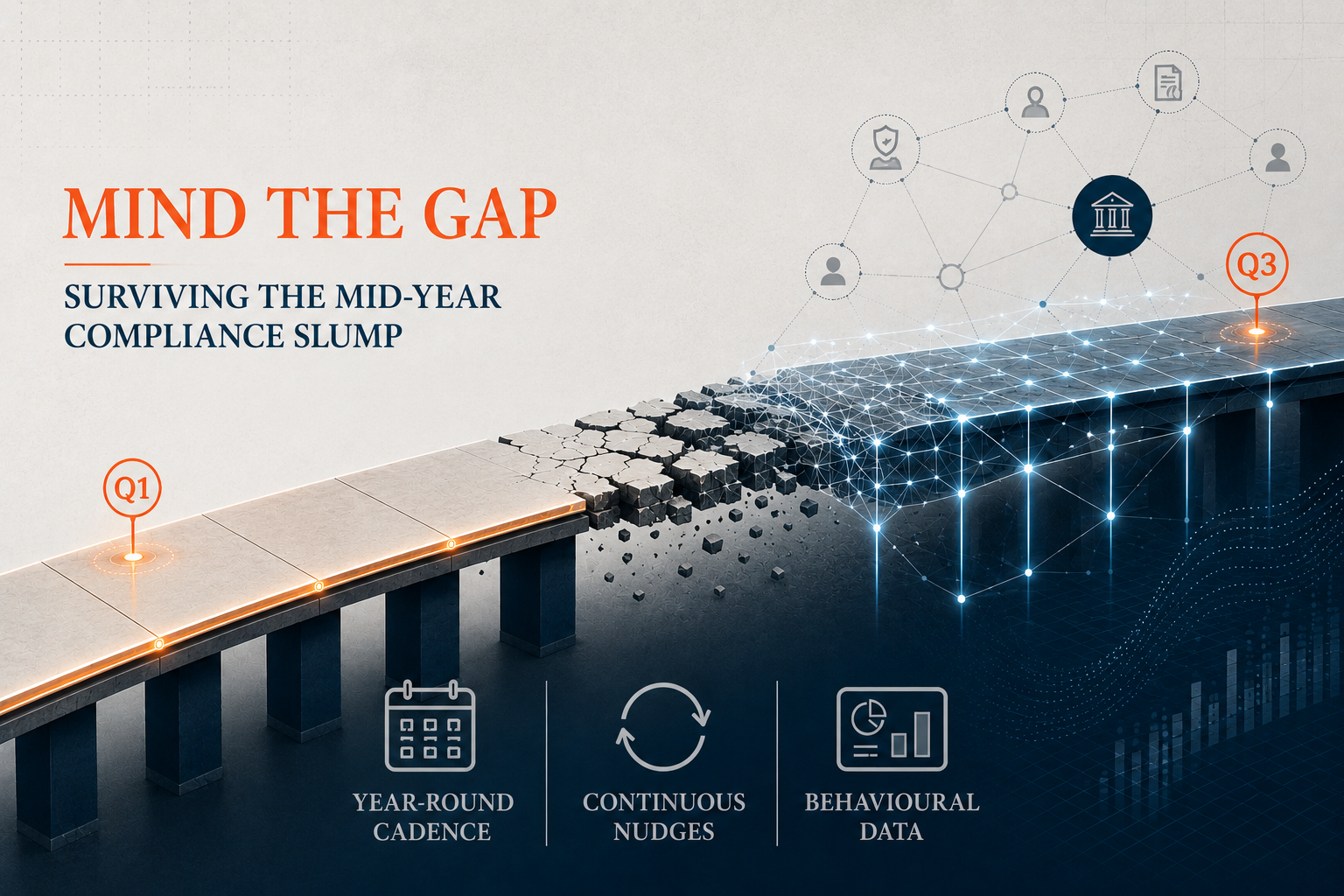
Picture the typical GCC corporate town hall in January.
The CEO stands on a stage in Dubai or Riyadh, projecting a massive slide about “Integrity in 2026.” HR launches the new, revamped Code of Conduct. The Legal team rolls out the mandatory Data Privacy module. Middle managers send cascading emails with strict deadlines. For four weeks, the organization is a hive of forced compliance. The dashboard lights up green. Completion rates hit 98%.
The executive team breathes a collective sigh of relief, ticks the “Culture” box, and goes back to their day jobs.
Then comes July.
The initial launch hype has evaporated. The CEO hasn’t mentioned the Code of Conduct in six months. A line manager in procurement, drowning under Q3 targets, casually bypasses a third-party due diligence check to close a vendor deal. A new batch of expatriate hires, who joined in May, were rushed through a disjointed onboarding process and have no idea how the company’s Speak-Up mechanism actually works.
Welcome to the Mid-Year Compliance Slump. In the Middle East, getting compliant for a month is essentially a bureaucratic exercise. Staying compliant for a year is a structural, behavioral war.
The Sugar Rush of Regulatory Implementation
The Gulf is currently experiencing regulatory whiplash. With the aggressive enforcement of the Saudi Personal Data Protection Law (PDPL), the UAE’s sweeping labor reforms, and intense ESG disclosure mandates from regional exchanges, companies are in a constant state of reactive sprinting.
The problem with a sprint is that it fundamentally misinterprets how human behavior works. GCC boards are confusing implementation with embedment.
Implementation is buying a tool and forcing people to use it once. It is an event. Embedment is what happens when no one is watching. It is a sustained ecosystem. When organizations rely entirely on the “sugar rush” of a Q1 compliance launch, they inevitably hit the Q3 cliff. Memory decays, old habits resurface, and the organization’s behavioral risk footprint quietly expands while the board looks the other way.
The Anatomy of Compliance Fatigue
Why do employees stop caring? It isn’t because they are inherently unethical. It is because of cognitive overload.
A striking study by Gartner found that employees’ capacity to absorb change without fatigue was cut in half, underscoring how constant change can overwhelm workers. In the modern enterprise, employees are bombarded with shifting rules, complex software protocols, and dense PDF policies. When training is treated as an annual, two-hour lecture devoid of cultural context, the brain simply tunes it out.
In the GCC, this fatigue is compounded by the region’s unique labor dynamics. The Gulf operates on high-velocity expatriate turnover and rapid scaling. If you exhaust your training budget and leadership capital ensuring everyone is compliant in Q1, what is your strategy for the 15% of your workforce that joins the company between April and September? Do they inherit the culture you built, or do they inherit the mid-year slump?
Moving from “Events” to “Embedment”
To survive the back half of 2026, Risk, HR, and Compliance leaders must shift their strategy from episodic events to continuous nudges. This requires dismantling the “annual refresher” mindset and adopting an ecosystem approach.
Here is how the smartest GCC organizations are bridging the gap:
1. Micro-Learning over Mega-Modules
You cannot fight compliance fatigue with more compliance. Instead of a dense, 90-minute anti-bribery course, you need short, hyper-contextualized digital modules deployed strategically throughout the year. Three minutes on navigating local vendor gifts before Ramadan. Five minutes on data privacy right before the Q3 reporting push.
2. Standardized, Scalable Onboarding
The culture a new hire experiences in July must be identical to the culture a legacy employee experienced in January. This requires a robust, digitized onboarding framework that does not rely on the fluctuating bandwidth of middle managers.
3. Auditing the “Say-Do” Gap
Surviving the mid-year slump means tracking data beyond completion rates. Are whistleblowing reports going up or down? Are comprehension scores dropping among mid-level managers? You must actively measure the gap between what the company says its culture is, and what the data proves it does.
Sustaining the Standard with Rainmaker
This is the exact transition Rainmaker facilitates for corporate boards across the Middle East. We know that a PDF policy cannot sustain momentum.
We build continuous, digital-first Culture, Compliance, and Leadership Development ecosystems. By hosting our dramatized, culturally intelligent e-modules on our RMEXP Learning Management System or licensing them to yours, we help you replace the Q1 sugar rush with a drip-feed of behavioral reinforcement.
We ensure that the ethical standard you set at the beginning of the year is the exact same standard your team executes in December, providing your audit committee with the empirical data to prove it.
The mid-year slump is not an accident; it is the predictable result of bad architectural design. Don’t let your compliance culture die on the vine.
🌍 Explore Culture & Compliance Embedment Strategies: https://rainmaker.co.in/culture-learning-solutions-for-middle-east/
📞 Speak to our GCC Strategists: +91 90290 00180
📧 Contact us: [email protected]