
The AI Governance Imperative: Managing Data Privacy in the Era of LLMs
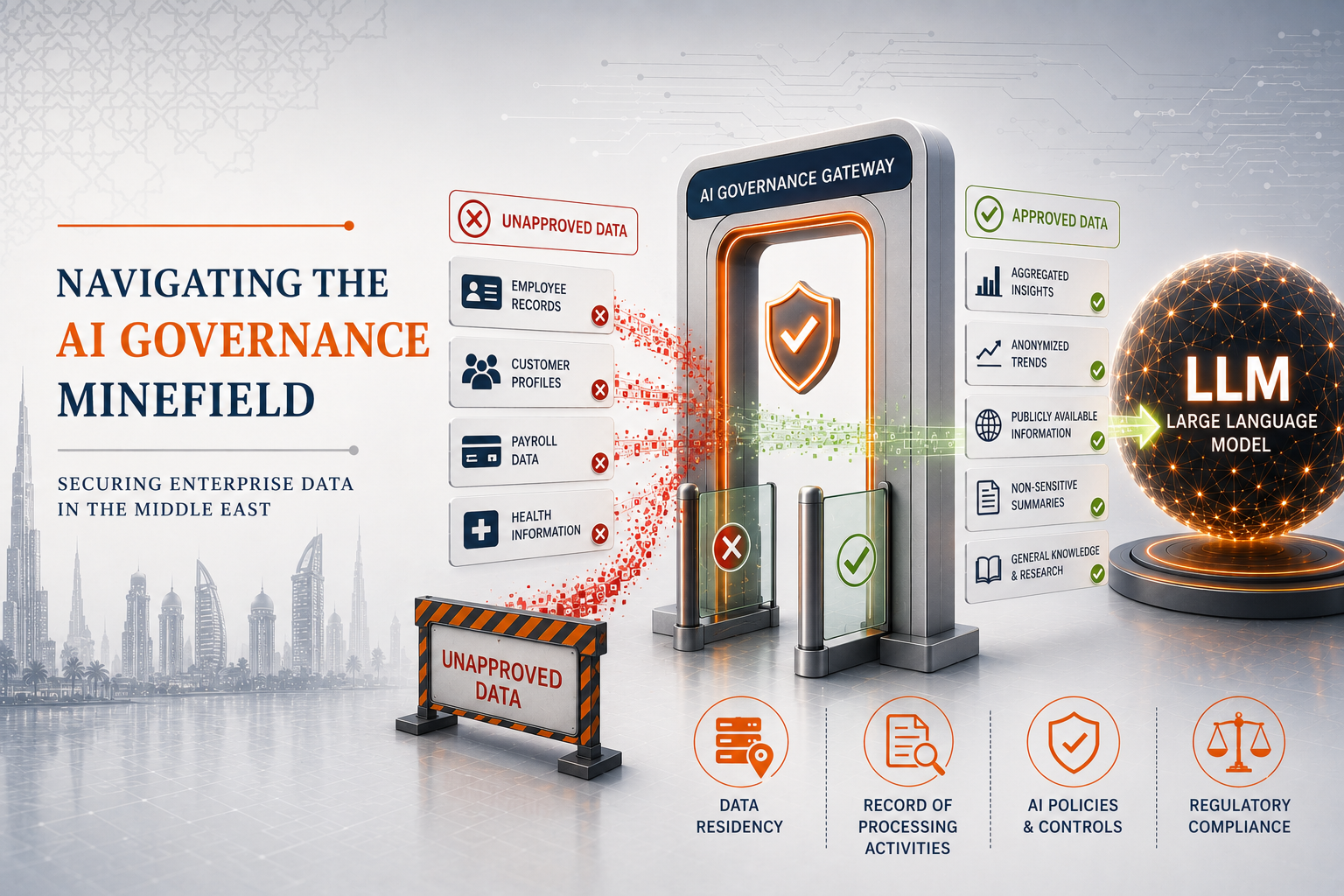
It usually starts with a harmless request. A marketing director at a Dubai based retailer drops a CSV file of customer purchasing habits into a public Large Language Model. They want a rapid analysis of buying trends. In seconds, the AI spits out a brilliant strategy.
But in that exact same fraction of a second, the company has committed a massive regulatory breach.
Welcome to the new reality of doing business in the Middle East in 2026. The region is accelerating toward an AI driven future, fueled by the massive ambitions of Saudi Vision 2030 and Oman Vision 2040. But this technological sprint has collided directly with a very rigid wall. Data privacy laws have matured, and regulators are no longer issuing polite warnings.
For boards and C-suite leaders across the GCC, artificial intelligence has morphed from a purely innovative tool into a profound, existential compliance risk.
The End of the Grace Period
To understand the shift, you have to look at the enforcement data. In Saudi Arabia, the Personal Data Protection Law is now actively enforced by the Saudi Data & Artificial Intelligence Authority. The penalties are not a slap on the wrist. Administrative fines for non compliance can reach up to SAR 5 million per violation. Furthermore, SDAIA now demands immediate, documented evidence of how data flows through an organization.
Oman has followed a similarly strict path. The Oman PDPL Executive Regulations mandate rigid 72 hour breach notification protocols and complex authorization processes for any specialized data processing.
The message from regulators is loud and clear. Having a privacy policy tucked away on a corporate intranet is no longer enough. Organizations must prove active, operational compliance.
Why Generative AI Breaks the Old Rules
Traditional compliance frameworks were built for static databases. They were not designed for dynamic, data hungry LLMs.
When employees use AI to draft emails, analyze contracts, or summarize meetings, they are actively processing data. If that LLM is hosted on servers outside the GCC, the organization is initiating an unauthorized cross border data transfer. Under the current KSA and Oman PDPL frameworks, doing this without explicit, documented user consent is illegal.
Data sovereignty is the new business barrier. It is just as critical as your tax code. If your enterprise relies on AI solutions hosted on foreign servers, you are navigating a legal minefield. If a vendor processes Saudi or Omani data in a different jurisdiction, your organization retains the primary legal liability.
The Governance Gap
This is where most organizations fail. They treat AI adoption as an IT procurement issue, completely ignoring the human element. The reality is that your employees are the ones feeding data into these models every single day.
AI governance is now a mandatory pillar of data privacy. You must document exactly what data feeds into these models, where the servers reside, and whether the models utilize employee inputs for future algorithm training. Failing to map these data flows exposes the company to immediate regulatory intervention.
Fixing the Culture, Not Just the Tech
Leaders must take immediate action. You need to update your Record of Processing Activities to include all AI systems. You must establish strict, localized AI Acceptable Use Policies. You have to audit your vendor contracts for compliance with KSA and Oman residency requirements.
But most importantly, you have to change employee behavior. Policies are entirely useless if your workforce does not understand the risk.
This is precisely where globally recycled compliance training falls flat. A generic, animated course on European GDPR will not resonate with a manager in Riyadh or Doha. To mitigate these modern risks, your organization needs localized, culturally nuanced learning solutions. Employees need to understand how their daily interactions with AI directly impact the company’s standing with local regulators.
Rainmaker is the premium partner for Culture, Compliance and Leadership Development in the Middle East. We provide digital first, scalable learning modules designed exclusively for the GCC corporate landscape. Our programs translate complex regional regulations into practical, everyday business behavior. We help your workforce understand the real world implications of the KSA PDPL, the Oman PDPL, and AI governance.
We ensure your team knows how to interact with emerging technology safely, legally, and ethically. By partnering with Rainmaker, organizations build high performing cultures that protect their reputation, ensure regulatory defensibility, and enable sustainable growth.
The AI revolution is here. Make sure your compliance culture is ready for it.
🌍 https://rainmaker.co.in/culture-learning-solutions-for-middle-east/
📞 +91 90290 00180