
The AED 300,000 Invoice: Why UAE Regulators Are Making Compliance Personal
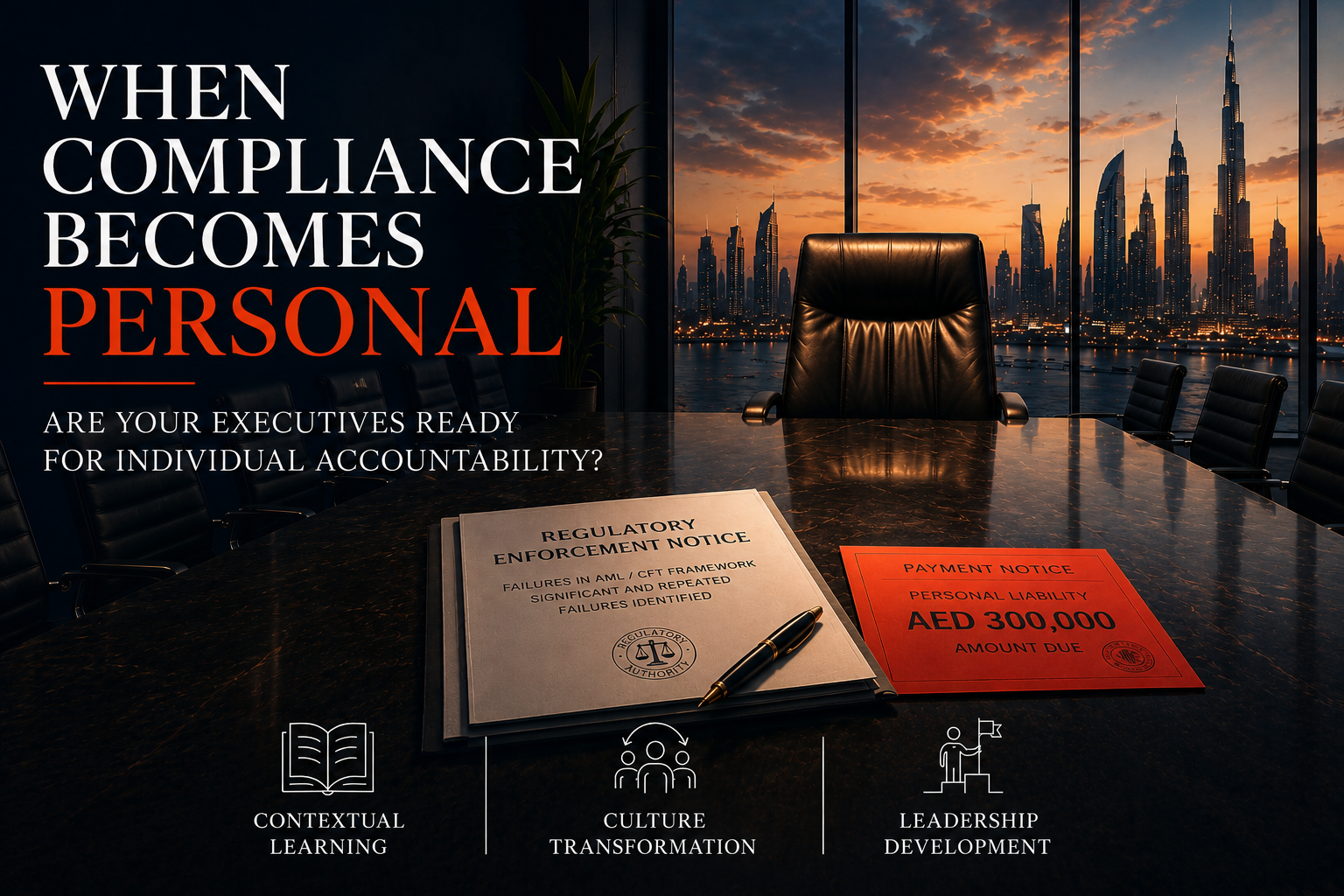
Let us talk about what actually happens behind closed doors when a massive regulatory fine hits the news.
Recently, the Central Bank of the UAE (CBUAE) handed down an AED 20 million penalty to a foreign bank branch. For a multinational institution, twenty million dirhams is a painful hit. Boards hold emergency meetings, legal teams draft remediation plans, and the corporate entity absorbs the financial shock as the cost of doing business.
But this time, the regulator did something that should make every C-suite executive, Board member, and HR Head in the GCC sit up and pay attention. The CBUAE levied a personal AED 300,000 fine directly against the bank’s Head of Compliance and Money Laundering Reporting Officer (MLRO).
Think about that for a second. The traditional corporate shield was bypassed. We are now looking at personal, out-of-pocket financial liability for systemic organizational failures.
The Myth of the Global Playbook
How does a senior executive end up with a personal six-figure fine? It usually starts with a very dangerous assumption.
Many foreign branches operating in the Gulf believe that the thick, heavily audited compliance manual exported from their global headquarters will automatically protect them in Dubai, Abu Dhabi, or Riyadh. But a global playbook means very little if it does not translate to daily, localized operations.
The CBUAE investigation shattered the illusion that paper policies equal protection. The regulator specifically noted that the MLRO failed to fulfill their distinct position functions. More importantly, the regulator cited “significant and repeated failures” across the organization’s Anti-Money Laundering (AML) and Combating the Financing of Terrorism (CFT) frameworks.
In the world of regulatory enforcement, the word “repeated” is a smoking gun. It means this was not an isolated software glitch. It was a cultural breakdown.
Why “Repeated Failures” Are a Culture Problem
Most organizations have the right legal guidelines on paper. Yet, multi-million dirham breaches keep happening. Why? Because a written policy cannot govern human behavior if the organizational culture actively works against it.
When a regulator finds repeated failures, it tells them a specific story about your workplace:
- Your people do not know what to look for: Frontline employees cannot identify the nuanced, everyday red flags regarding money laundering or third-party risk.
- Your Speak-Up culture is broken: Teams do not feel psychologically safe reporting suspicious activities. They fear retaliation, so they stay quiet until it is too late.
- Your leadership priorities are misaligned: If leadership fails to set the right tone at the top, employees naturally view compliance as a hurdle they must bypass to hit their revenue targets.
The Middle East is Playing by New Rules
The UAE regulatory environment is operating on a completely new frequency. Since successfully exiting the FATF grey list in early 2024, the nation has maintained relentless momentum to prove its position as a highly secure, tier-one global financial hub.
Regulators are no longer content with checking if you have an Anti-Bribery and Anti-Corruption (ABAC) policy on your intranet. They are aggressively auditing operational reality. They want to see a living, breathing culture of ethics.
How Rainmaker Helps You Sleep at Night
You can buy the most expensive transaction monitoring software on the market. But if your organizational culture is broken, your institution and your executives remain incredibly vulnerable.
Building a defensible, regulator-approved culture requires continuous and highly engaging capability building. This is where Rainmaker partners with leading GCC organizations. We help businesses move beyond generic, globally recycled training modules to create learning experiences that actually resonate with the regional workforce.
We help organizations mitigate boardroom risk through:
- Contextual Compliance Learning: Deep-dive, scenario-based training on AML, ABAC, and Data Privacy that reflects actual Middle Eastern business realities.
- Culture Transformation: Establishing robust Speak-Up frameworks and anti-harassment protocols that build authentic psychological safety and trust.
- Leadership Development: Equipping your C-suite and middle managers with the practical skills to lead with integrity, navigate ethical dilemmas, and definitively prove “tone at the top” to regulators.
Your compliance manual will not stop the next regulatory breach. Your people will. Ensure your teams have the culture and leadership necessary to make the right decisions when it matters most.
Take the Next Step
Do not wait for a CBUAE inspection to test the strength of your corporate culture or the personal liability of your leadership team. Connect with Rainmaker today to future-proof your organization’s integrity.
🌍 https://rainmaker.co.in/culture-learning-solutions-for-middle-east/
📞 +91 90290 00180