
Dear 2013 Me: An Open Letter from India’s PoSH Act
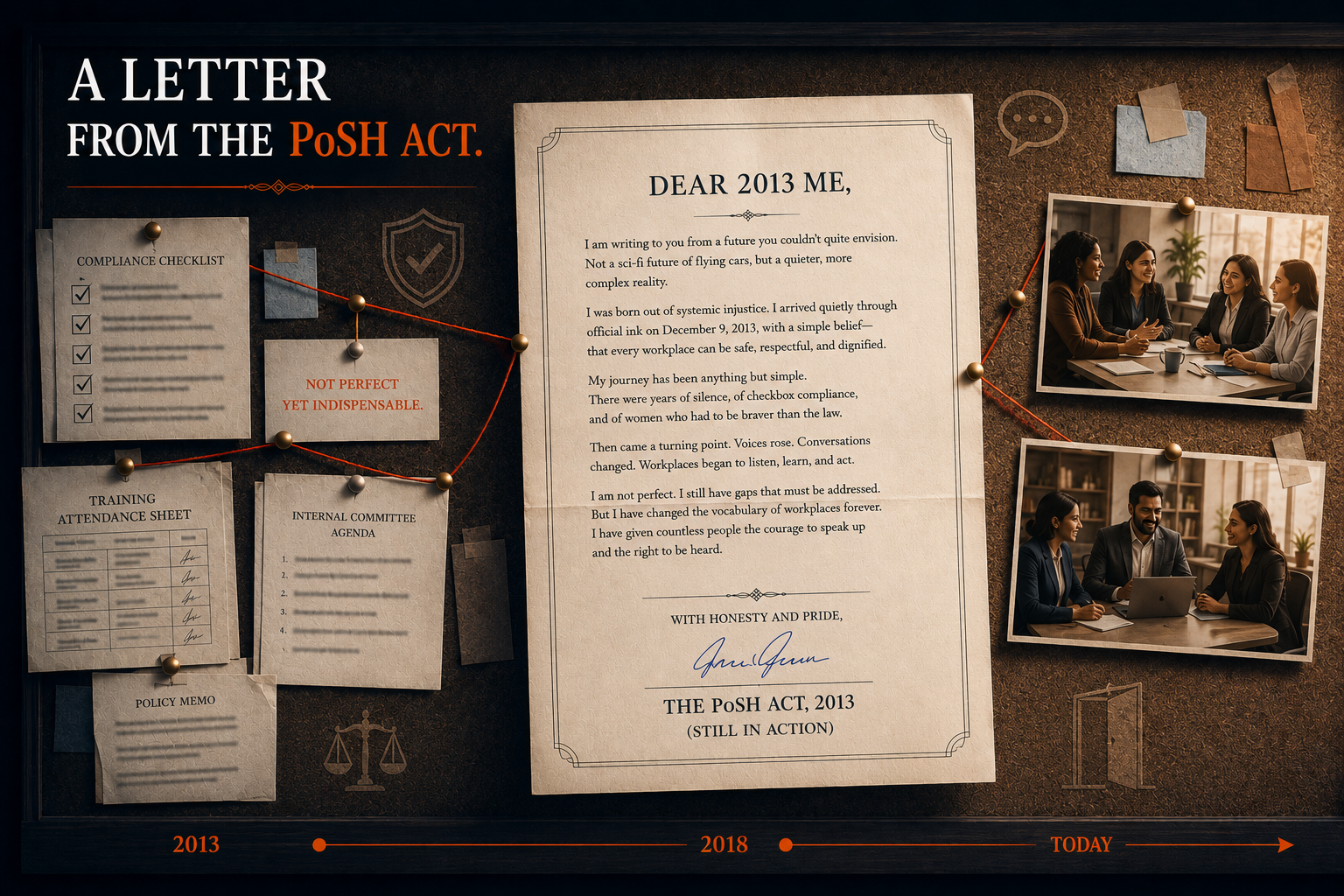
Dear 2013 Me,
I am writing to you from a future you couldn’t quite envision. Not a sci-fi future of flying cars, but a quieter, more complex reality.
It’s a future where my name is debated in Mumbai boardrooms, codified into Bengaluru startup offer letters, and scrutinized in Delhi courtrooms. It is a reality where Internal Committee (IC) members lose sleep over my clauses, and where employees whisper my name to one another as a form of quiet reassurance.
I always knew my existence would be messy. When you are born out of systemic injustice, you know the ecosystem you are entering is inherently flawed. But I arrived anyway, with a straight spine and crisp gazette pages.
Here is what the journey has actually looked like.
The Genesis: A Quiet Arrival
I remember the day I was enacted. There were no front-page parades. I arrived quietly through official ink: December 9, 2013. The halls of Parliament had spent years arguing over my fine print, a delayed response to the Supreme Court’s 1997 Vishaka Guidelines. And then, just like that, I became real: The Sexual Harassment of Women at Workplace (Prevention, Prohibition and Redressal) Act, 2013. Today, corporate India simply calls me PoSH.
I was young and perhaps a bit naive. I believed my mere existence would trigger an overnight metamorphosis. I thought the moment I was signed into law, power dynamics would magically invert, and every woman who had ever swallowed her discomfort would finally feel safe.
I had a steep learning curve ahead.
The “Checkbox” Era: What I Didn’t Anticipate
I did not anticipate the deafening silence of paper compliance.
Between 2013 and 2017, I walked into Indian enterprises and found that I was a ghost. HR managers filed me away in compliance folders. Legal teams skimmed my mandates. The Internal Committees (ICs) I demanded existed purely as names on dusty policy documents.
Consider Swati, a marketing executive in Pune. In 2015, she experienced behavior that explicitly violated my provisions—but she didn’t know my name yet. Her company technically had an IC, but when she finally knocked on that door, the HR representative looked just as lost as she felt.
I learned a hard truth then: change rarely arrives on the wings of moral enlightenment. Often, it sneaks in through the backdoor of compliance fear. Workplaces began adopting me not out of principle, but to avoid penalties. And I decided that was an acceptable start.
The Catalyst: When the World Woke Up
Then came 2018, and the ground shifted.
The #MeToo movement crossed oceans and broke down India’s corporate doors. Women in corner offices, newsrooms, hospitals, and factory floors stopped whispering. At immense personal cost, they spoke up loudly.
For me, it was a moment of profound, aching relief. Suddenly, organisations that hadn’t looked at my pages since 2013 scrambled to schedule comprehensive PoSH training sessions. I was dusted off, re-read, and genuinely implemented.
PoSH training evolved from a legal checkbox into a behavioral reckoning. Employees finally understood that sexual harassment wasn’t just physical. It was the colleague whose late-night texts induced Monday morning dread. It was the manager whose “harmless jokes” were consistently targeted. It was the suffocating accumulation of microaggressions.
Where they functioned correctly, ICs became remarkable quasi-judicial bodies, armed with the power to summon witnesses, examine digital evidence, and enforce consequences. I had successfully built a structure that relied on mandatory accountability, not corporate goodwill.
The Gaps: What the Headlines Revealed
The influx of cases brought both pride and discomfort.
I saw women like Rekha, a Delhi-based editor whose 2014 complaint was buried, successfully utilize my framework in 2018 to see an inquiry completed in 78 days. The law hadn’t changed; the room’s willingness to take her seriously had.
But scale exposes structural flaws. My original design had loopholes. Some organizations weaponized the “false complaints” provision to intimidate genuine aggrieved. Cases emerged of ICs packed with leadership loyalists, proving exactly why the role of an unbiased External Member is the linchpin of corporate justice. Every exposed failure forced a tighter interpretation of my clauses.
The Stinging Truth: I Am Incomplete
Now, for the part that requires absolute candor.
I was written exclusively for women. My architecture, definitions, and protections are deeply gendered. In 2013, given the sheer statistical scale of violence against women, that was a defensible, necessary triage.
But as corporate India matures, the question grows louder: What about other genders? LGBTQ+ professionals and male employees face profound harassment, and under my strict legal definition, I cannot protect them.
I am not cruel; I am simply incomplete. Progressive organizations have started building workarounds, instituting gender-neutral internal policies that mirror my protections. But a workaround is not a legislative cure. This is a burden my advocates must keep naming until the law catches up with reality.
The Legacy
To you, 2013 Me: Do not lose sight of the tectonic shift you initiated.
You were born because women had been filing complaints into a void for decades, and you finally gave that void a timeline, a structure, and a consequence. You are not perfect, but you changed the vocabulary of Indian business. You told every employer that a safe workplace is not an HR perk, it is a non-negotiable mandate.
You were brave to be born into a world not yet ready for you. The foundation you laid is strong, and the work you began is far from over.
With honesty and pride,