
Culture, Compliance & ESG in the GCC: Turning Ethics into Audit-Ready Data
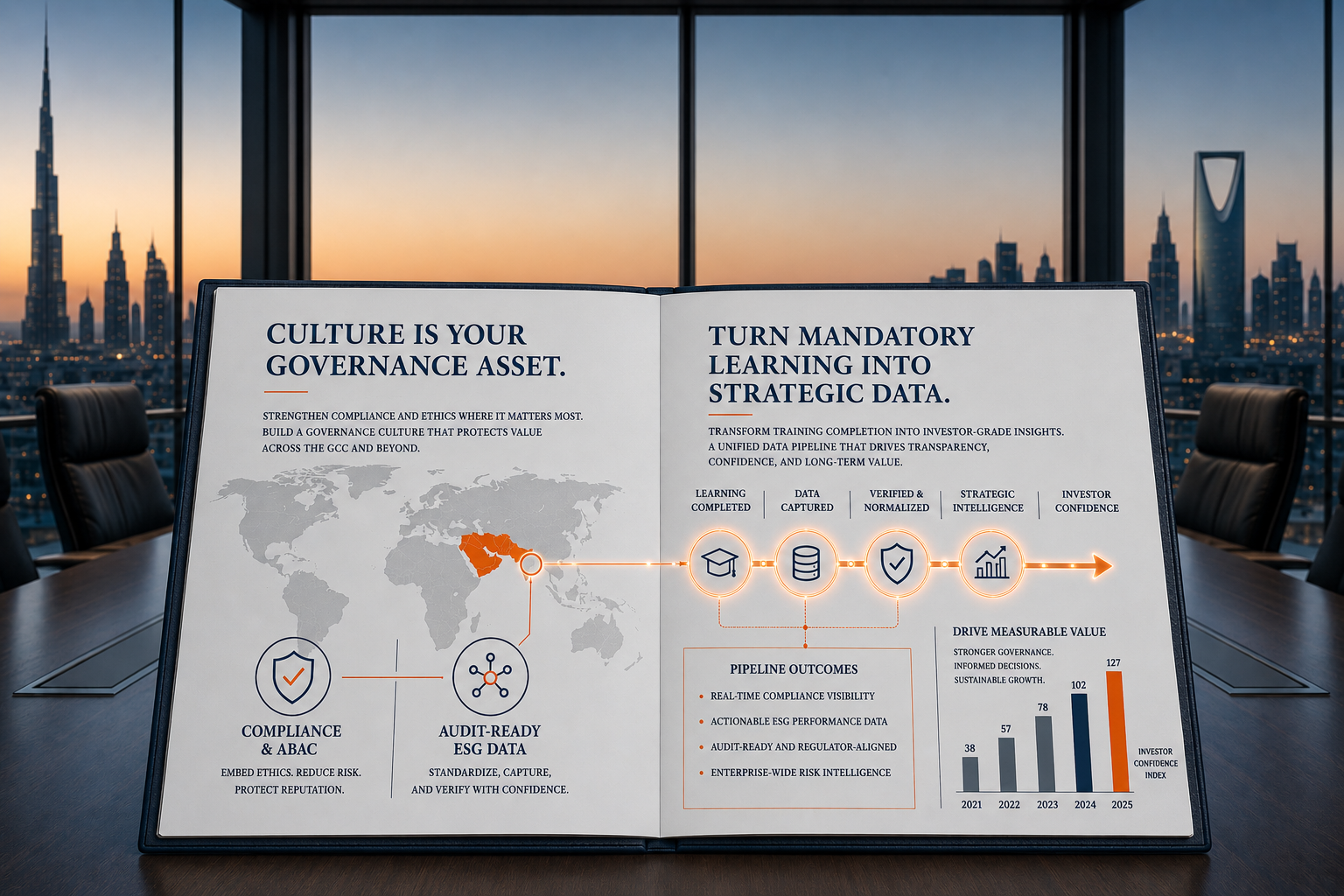
How “soft” culture metrics became the hardest data in your 2026 annual report.
For years, corporate culture in the Middle East was viewed as a “soft” HR priority – difficult to measure, harder to report, and largely disconnected from the capital markets. Today, that narrative is obsolete.
When your organization conducts an anti-bribery and anti-corruption (ABAC) training session in Riyadh, or an anti-harassment and workplace respect workshop in Dubai, it is no longer just an internal HR exercise. It is a critical data generation event for your annual ESG (Environmental, Social, and Governance) disclosures.
In the GCC, the dots between Culture, Compliance, and ESG are now fully connected. With global frameworks standardizing disclosures and local regulators turning up the heat, the question for regional boards and C-suites is no longer “Are we ethical?” but rather, “Can we prove our ethics to investors with audit-ready data?”
The New Regulatory Reality in the Gulf
The transition of culture from a localized HR function to a boardroom ESG imperative is being driven by a wave of new reporting requirements. Investors and regulators across the region are demanding empirical evidence of the “S” (Social) and “G” (Governance) pillars.
Here is how compliance learning directly feeds your regulatory mandates:
- ISSB (IFRS S1) Governance Mandates: The International Sustainability Standards Board requires organizations to provide evidence of how their governance bodies oversee, monitor, and manage culture-related risks. A robust, digitized leadership development and compliance learning program serves as direct evidence of this oversight.
- GRI 205 – Anti-Corruption: The Global Reporting Initiative explicitly requires the disclosure of the percentage of employees, broken down by region and employee category, who have received anti-corruption training.
- GCC Capital Market Pressures: Both the Abu Dhabi Securities Exchange (ADX) ESG Guidelines and the Saudi Exchange (Tadawul) ESG Disclosure Guidelines place a heavy emphasis on ethical conduct controls, diversity, and inclusion. Organizations looking to attract foreign direct investment aligned with Vision 2030 or “We the UAE 2031” must translate their internal code of conduct into standardized investor reporting.
The Disconnect: Are Your Teams Talking?
Despite these regulatory pressures, a dangerous silo effect exists in many GCC organizations.
- HR and Learning & Development (L&D) deploy the training.
- Legal and Compliance write the Code of Conduct and handle whistleblowing investigations.
- Sustainability / ESG teams scramble at the end of the fiscal year to find the data required for the annual report.
This fragmentation creates a massive risk. If you are conducting third-party ethics training for your supply chain, but your Sustainability Officer cannot access the completion metrics and comprehension scores, you are leaving critical ESG value on the table. You are doing the hard work, but failing to capture the capital reward.
From Training Room to Annual Report: The ESG Data Flow
To turn culture into capital, organizations need a systematic approach to data capture. When deployed strategically, a compliance module acts as a powerful data engine.
- The Activity: Employees and leadership teams in your GCC offices complete localized, culturally sensitive modules on Workplace Respect, Data Privacy, or Speak-Up cultures.
- The Data Generation: A premium digital learning solution captures more than just a “tick” in a box. It records granular completion rates, scenario-based comprehension scores, and immutable policy attestations.
- The Framework Mapping: This raw data is mapped directly to the corresponding ESG frameworks (e.g., matching ABAC completion rates to GRI 205).
- The Disclosure: Your final ESG report features defensible, audit-ready data: “In 2026, 100% of our high-risk procurement staff across the UAE and KSA completed localized supply-chain integrity training, with an average comprehension score of 94%.”
How Rainmaker Bridges the Gap
At Rainmaker, we understand that generic, globally recycled corporate training falls flat in the Middle East. It fails to engage employees, and worse, it fails to provide the robust analytics that modern boards require.
We are a strategic Culture, Compliance, and Leadership Development partner built for this exact tension. Our digital-first learning solutions are localized for the GCC, respecting regional nuances, hierarchy, and business dynamics, while being engineered to capture the exact data points your ESG team needs.
We don’t just help you build a compliant culture; we help you build a defensible one. By transforming mandatory learning into strategic data, Rainmaker ensures that your organization’s commitment to ethics, governance, and respect translates seamlessly into market trust and investor confidence.
Actionable Next Steps for GCC Leaders
Don’t wait for your next audit to test your data pipeline. Take these three steps this week:
- Audit Your Silos: Bring your CHRO, Chief Compliance Officer, and Head of Sustainability into the same room. Ask them how compliance training data is currently handed over for ESG reporting.
- Review Your Content: Are your current ethics modules culturally resonant for a GCC workforce, or are they skipped through as a boring, Western-centric chore? (Low engagement equals poor data).
- Upgrade Your Tech: Ensure your learning partner can provide real-time, framework-mapped analytics that stand up to external auditor scrutiny.
Your culture is your strongest governance asset. Start measuring it like one.
🌍 Explore ESG Data & Culture Solutions: https://rainmaker.co.in/culture-learning-solutions-for-middle-east/
📞 Speak to our GCC Strategists: +91 90290 00180
📧 Contact us: [email protected]