
Corporate Liability: Is Your Anti-Bribery Compliance Framework Investigation- Ready?
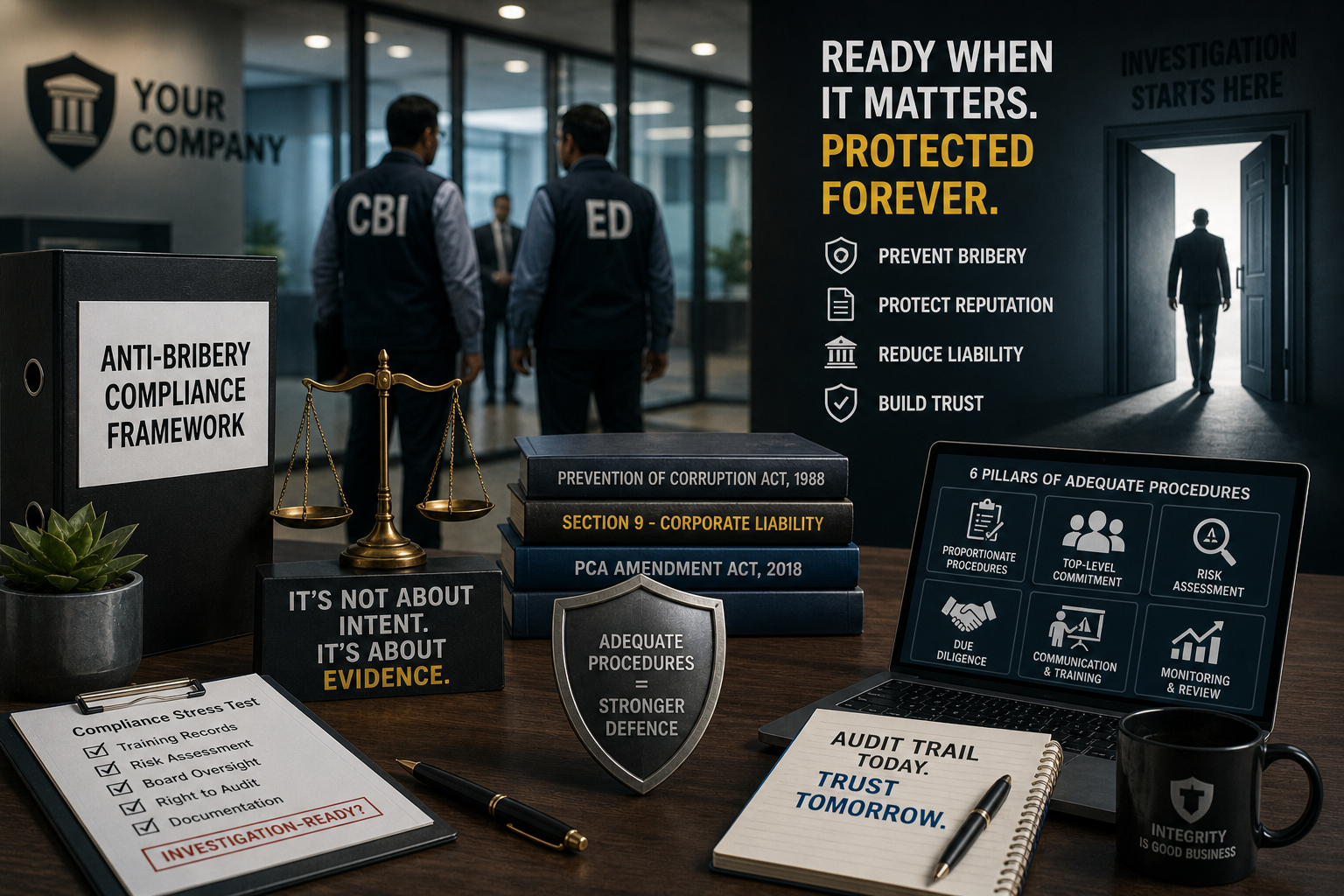
The phone at your front desk rings, and the receptionist’s voice is tense. Officials from the Central Bureau of Investigation (CBI) or the Enforcement Directorate (ED) are waiting in the lobby.
They are not here for a routine visit. A vendor linked to your business has been flagged for an unlawful payment to a public official, and the investigators have only one question for your leadership team: “What did your company do to prevent this?”
In that precise moment, your good intentions, your company’s core values, and your generic policy documents will not save you. Only your audit trail will. If you cannot demonstrably show what you did to proactively prevent bribery, your compliance framework could be considered merely an illusion, and it will not hold up under regulatory scrutiny.
The Indian Reality: Section 9 of the PCA
For years, Indian companies often felt shielded by the “rogue employee” defense, assuming that if a third-party agent or an individual staff member acted out of line, the organisation itself was insulated from the fallout. The Prevention of Corruption (Amendment) Act, 2018 fundamentally altered the corporate liability landscape.
Under Section 9 of the Prevention of Corruption Act, 1988 (PCA), if any person associated with a commercial organisation, be it an employee, a subsidiary, or a liaison agent bribes a public servant to obtain or retain business, the company itself is held liable. However, the law provides a critical lifeline: a defence based on adequate procedures. If your company can prove it had robust, diligently maintained procedures in place to prevent such conduct, it may be better placed to defend itself.
The distinction is clear: Are your procedures an aspiration, or are they an operational reality? In an investigation, that distinction dictates whether you face a penalty or a path to exoneration.
The 10-Second Compliance Stress Test
Take a moment to evaluate your current framework. Answer ‘Yes’ or ‘No’ to the following questions:
- Can you pull out a specific employee’s three-year-old anti-bribery training log in under thirty minutes?
- Does your Risk Register name specific high-risk Indian departments, municipalities, or states?
- Has your Board of Directors formally discussed compliance with anti-corruption and anti-bribery laws within the last twelve months?
- Do your contracts with agents and consultants include a “Right to Audit” clause that empowers you to examine their records for red flags?
If you answered “No” to any of these, your framework may not survive a regulatory stress test.
A Global Benchmark in Defence: The Morgan Stanley Case
To understand what a defensible compliance framework looks like in practice, we can look to a widely reported global enforcement example under the Foreign Corrupt Practices Act, 1977 (FCPA). While not a direct Indian precedent, the 2012 Morgan Stanley case perfectly illustrates how documentation saves reputations.
The incident involved Garth Peterson (a managing director in Morgan Stanley’s real estate investment and fund advisory business) who secretly acquired millions of dollars worth of real estate investments for himself and a Chinese public official who steered business to Morgan Stanley’s funds. Peterson also arranged for himself, the official, and an attorney to acquire a valuable Shanghai real estate interest disguised as finder’s fees.
The authorities prosecuted Peterson aggressively, but they explicitly declined to take any enforcement action against Morgan Stanley. Why? Because the firm could prove its compliance program was diligently maintained. They did not just have a policy on paper; they had a verifiable history of action.
Investigators were shown proof that the employee was trained on anti-corruption laws seven separate times. The firm produced records of thirty-five distinct compliance reminders sent directly to him. Furthermore, active monitoring by compliance personnel had regularly tested his transactions, forcing him to use a complex web of deceit to hide the bribe. The system worked exactly as intended, proving that the company had done everything reasonably possible to prevent the misconduct.
Turning Aspiration into a Defensible Shield
In the absence of detailed notified guidance on “adequate procedures” under the PCA, forward-thinking organisations often look to the UK Ministry of Justice’s “Six Pillars” for practical direction. Here is how your institution can move from a paper policy to a robust shield:
1. Proportionate Procedures: Focus on the Grey Areas
Your rules must match the nature and scale of your operational realities. If your company interacts heavily with land authorities, customs, or licensing bodies, your controls must be inherently tighter. Establish clear, non-negotiable financial thresholds for gifts and hospitality, ensuring every rupee spent on government relations is documented with a legitimate business purpose.
2. Top-Level Commitment: Beyond the Signature
Regulators look for a culture of integrity that radiates from the Board level downward. A policy simply signed by an HR manager is insufficient. Ensure that Board minutes reflect active oversight of compliance risks, and that the C-Suite issues regular, firm-wide communications reinforcing a zero-tolerance approach to bribery.
3. Risk Assessment: Map Your Exposure
A generic risk assessment is an immediate red flag for investigators. Corruption risks in a manufacturing project in Maharashtra may look vastly different from a software deployment in Tamil Nadu. Maintain a Bribery Risk Register that identifies specific geographic or departmental hotspots where interactions with public officials are frequent.
4. Due Diligence: Know Your Associated Persons
In India, third-party middle folks or liaison agents (intermediaries) are often the primary source of risk. Because you are responsible for their actions under Section 9, third-party risk management must be rigorous. Conduct thorough background checks before onboarding any consultant and mandate ‘right to audit’ clauses in all vendor contracts.
5. Communication & Training: Prove They Understood
Relying on an annual check-the-box exercise will not hold up in court. You must be able to prove that the employee actually understood the rules. Deploy tailored, scenario-based training that reflects real-world Indian commercial pressures, and rigorously retain quiz scores and attendance logs as physical evidence.
6. Monitoring and Review: Test the Shield
A compliance program that is never tested is simply a paper program. Conduct internal stress tests on your controls. Direct your internal audit team to specifically look for red flags in consultancy fees, facilitation payments, or unusual commission structures.
The 2026 Leadership Imperative
As the Indian enforcement landscape continues to mature, the question for Boards is no longer whether they have an anti-bribery policy. The question is: “If our company’s survival depended on our records today, would our documentation tell a story of diligence, or a story of indifference?”
Investigation-readiness is not about achieving absolute perfection; it is about being legally and operationally defensible. It is the defining difference between a company that controls its own destiny and one that surrenders it to a regulator.
Build your audit trail today, so you do not have to rebuild your reputation tomorrow.
Are your compliance records ready for a regulatory knock on the door?
Don’t leave your corporate liability to chance. Contact Rainmaker today to explore our scenario-led, audit-ready Anti-Bribery & Anti-Corruption (ABAC) e-modules and culture audits, designed to protect your leadership team and align with the PCA, FCPA, and UKBA.
Suggested Reading
- WinZO PMLA Freeze 2025: ED Locks INR 505 Cr – 5 Lessons for Indian RMG Platforms | Rainmaker
- The Only PCA FAQ Indian Organisations Need for 2025—And How Rainmaker Makes Compliance Effortless
- The Cholamandalam Case: What It Reveals About India’s Corporate Governance And Regulatory Risk | Rainmaker
- Navigating M&A Compliance Risks: Protect Your Deal, Build Trust | Rainmaker