
The New Mandate for Middle East Boards: Auditing the Human Side of Risk
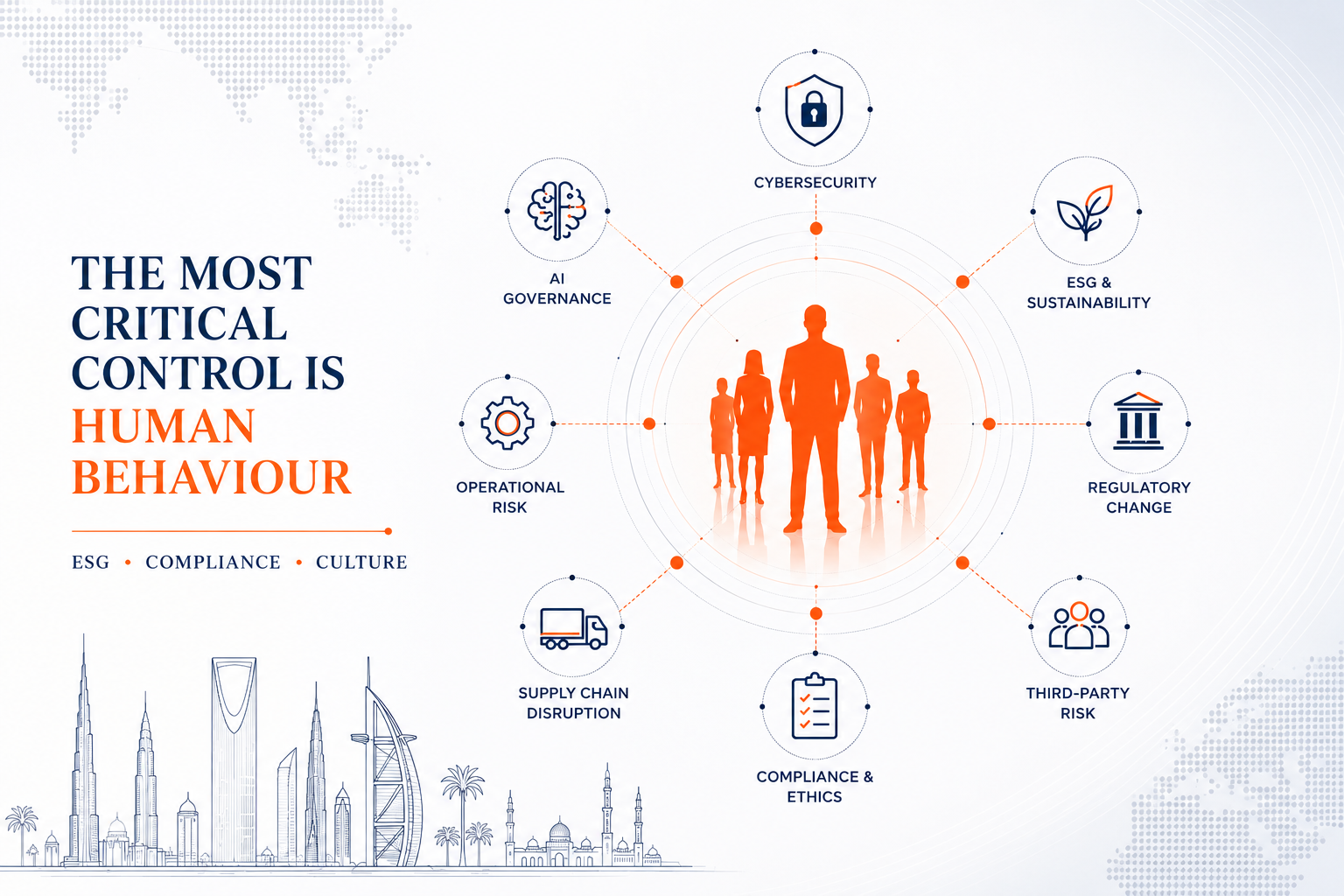
For decades, the mandate of the Chief Audit Executive (CAE) in the Middle East was unambiguous: safeguard the balance sheet, ensure operational efficiency, and maintain strict regulatory compliance. Today, as organizations across the Gulf Cooperation Council (GCC) aggressively digitize to align with national transformation agendas like Saudi Arabia’s Vision 2030 and “We the UAE 2031,” the traditional audit playbook is rapidly becoming obsolete.
A review of 2026 internal audit plans across the region reveals a stark paradigm shift. While financial controls remain foundational, the boardroom conversations in Riyadh, Dubai, and Doha are now dominated by interconnected, systemic threats. According to the IIA’s Middle East Risk in Focus report, while Cybersecurity remains the indisputable primary concern, risks associated with Digital Disruption (including AI), Human Capital, and Regulatory Change are surging to the top of the corporate agenda.
The common denominator across these escalating threats? Human behavior.
The modern CAE is now faced with a complex, uncomfortable question: How do you effectively audit culture and conduct?
The Human Element in Systemic Threats
To understand why culture must evolve from a subjective HR concern to a hard, auditable control, we must examine the behavioral root causes of the region’s top corporate risks.
1. Cybersecurity: The Fragility of the Human Firewall
Organizations in the GCC are investing billions in perimeter defense and zero-trust architecture. Yet, the 2025 Verizon Data Breach Investigations Report (DBIR) confirms a stubborn reality: the human element, comprising errors, social engineering, and privilege misuse, remains a primary driver in 60% of all cybersecurity breaches. Furthermore, the DBIR notes that third-party involvement in breaches has doubled year-over-year to 30%. You cannot audit a firewall out of human error; you must audit the behavioral resilience of your employees and your vendors.
2. AI Governance and Digital Trust
As GCC enterprises rapidly integrate Generative AI into their operations to drive efficiency, they are introducing unprecedented vulnerabilities. Research from EY on AI governance in the GCC highlights that AI investment is vastly outpacing governance maturity. The resulting “trust fragility” means that risks of bias, data leakage, and copyright infringement are skyrocketing. Auditing AI cannot be limited to reviewing algorithms; it requires auditing the ethical frameworks and the localized Code of Conduct guiding the employees who train and prompt these systems daily.
3. The ESG and Regulatory Squeeze
Capital markets in the region are demanding radical transparency. With frameworks like the Saudi Exchange (Tadawul) ESG Disclosure Guidelines and the incoming wave of IFRS S1/S2 standards, boards must provide evidence of how they oversee social and governance risks. When a regulator asks for proof of anti-bribery and anti-corruption (ABAC) oversight within your supply chain, a signed PDF policy is no longer sufficient evidence.
Bridging the Gap: Culture as an Auditable Control
If human behavior is the central vulnerability, then culture is the primary control. However, traditional corporate training fails the audit test. When organizations treat anti-harassment, ABAC, or data privacy modules as passive, “tick-the-box” exercises, they generate zero empirical value for the audit committee. Low engagement yields poor comprehension, and poor comprehension yields defenseless compliance data.
To bridge this gap, organizations must transition from tracking completion to measuring comprehension and behavioral intent.
This is where Rainmaker’s methodology becomes a strategic asset for GCC boards. We build digital-first Culture, Compliance, and Leadership Development solutions that are intentionally designed to generate audit-ready data. By deploying highly localized, culturally intelligent, and scenario-based learning modules, we ensure that employees in the Middle East aren’t just clicking “Next.”
More importantly, our solutions provide CAEs with the granular analytics required for a robust audit:
- Deep Comprehension Metrics: Moving beyond binary pass/fail to identify specific knowledge gaps within high-risk departments (e.g., Procurement or IT).
- Immutable Policy Attestations: Generating verifiable, timestamped data that satisfies regional regulators and external auditors.
- Cultural Nuance: Ensuring training on sensitive topics like Speak-Up mechanisms or Workplace Respect aligns with local GCC workplace dynamics, thereby increasing psychological safety and accurate reporting.
A Playbook for Chief Audit Executives
For IA to successfully transition from a reactive “police officer” to a proactive strategic advisor to the Board, CAEs must take three immediate steps:
- Dismantle the Silos: Internal Audit must partner directly with the CHRO, Chief Compliance Officer, and ESG leads. Establish a unified pipeline where cultural and behavioral data flows directly into the enterprise risk management (ERM) dashboard.
- Audit the Ecosystem, Not Just the Enterprise: With supply chain risks escalating, extend your behavioral audits to your third parties. Ensure your vendors are actively measured on their adherence to your ethical and ABAC standards.
- Upgrade the Evidence: Discard legacy training systems that only track attendance. Implement learning technologies capable of yielding the defensible, framework-mapped data required by the ISSB, GRI, and local exchange regulators.
Culture is no longer a soft metric. In 2026, it is the most critical variable on your balance sheet. Measure it accordingly.
🌍 Explore Risk & Culture Solutions: https://rainmaker.co.in/culture-learning-solutions-for-middle-east/
📞 Speak to our GCC Strategists: +91 90290 00180
📧 Contact us: [email protected]