
The August 2026 Deadline: A Survival Guide to the EU AI Act for Indian Tech
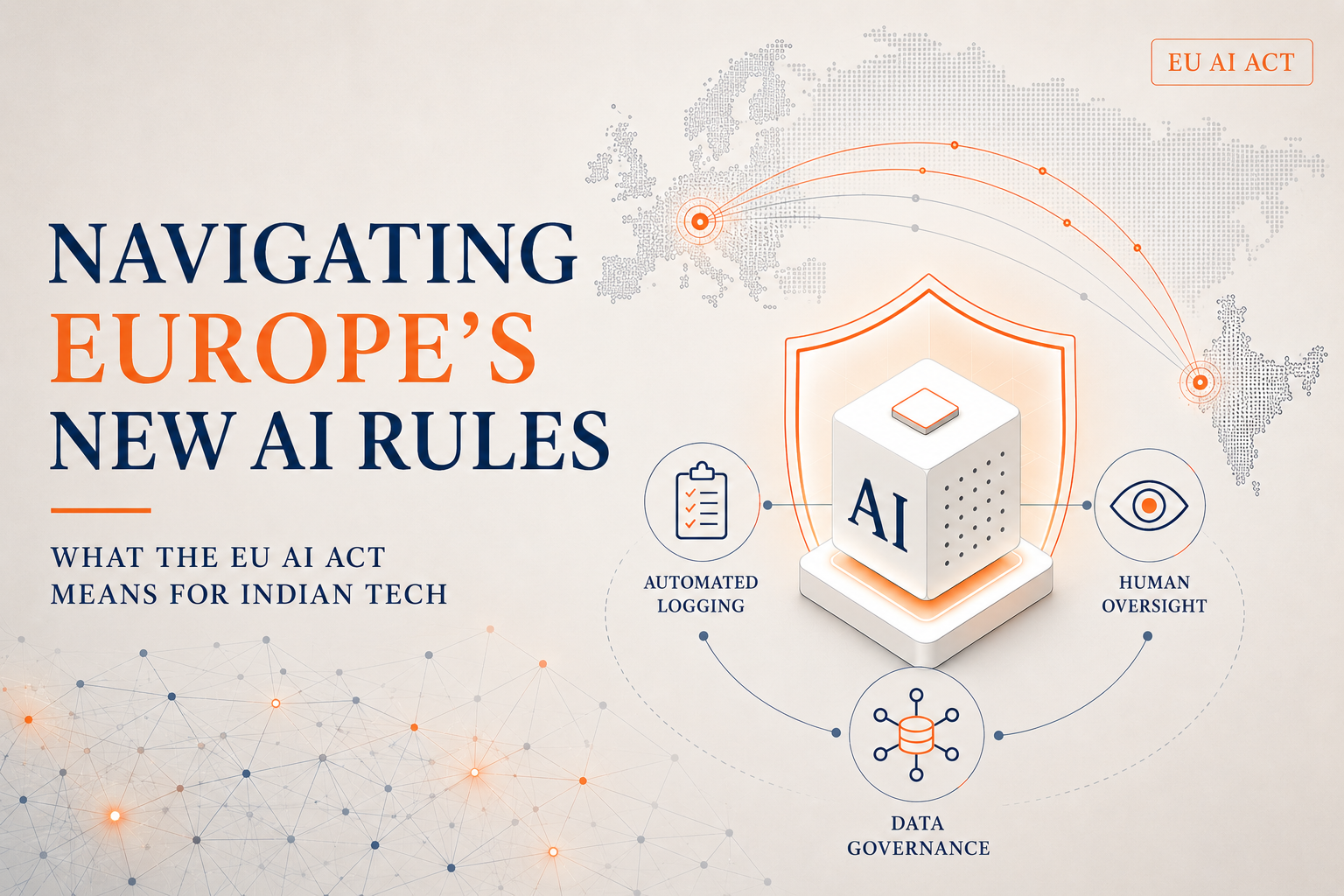
The Brussels Effect is back, and this time, it’s coming for your algorithms.
If you are an Indian founder, a product manager, or a compliance officer, you might remember the frantic scramble of May 2018. That was when Europe’s GDPR went live, fundamentally rewiring how the global internet handled personal data. Suddenly, “privacy by design” wasn’t just a buzzword; it was a baseline requirement to keep enterprise contracts alive.
Now, welcome to round two. The EU AI Act, the world’s first comprehensive legal framework for artificial intelligence, is here. And if you think this is just a European problem, or purely a headache for your legal team, it’s time to recalibrate.
The most critical deadline of the Act hits this summer on August 2, 2026, when the heavy operational requirements for “High-Risk” AI systems and General Purpose AI transparency rules become fully enforceable.
Here is a deep dive into why the EU AI Act is no longer a future roadmap item, but this sprint’s risk register and what your organization needs to do about it right now.
The Extraterritorial Reality
You don’t need a registered office in Berlin or Paris to fall under the AI Act’s crosshairs. The law operates on a principle of extraterritoriality based on impact.
If you are an Indian SaaS company building an AI-powered resume screening tool, and a European company uses it to hire candidates, you are liable. If your platform’s AI-generated outputs are simply used within the EU, you are inside the regulatory perimeter.
And the penalties are engineered to sting. Non-compliance can trigger fines of up to 7% of your global annual turnover or €35 million, whichever is higher. For scaling startups and established enterprises alike, that isn’t just a fine; it’s an existential threat.
The Risk Pyramid: How the EU Classifies Your Tech
The genius (and the burden) of the EU AI Act is its tiered, risk-based approach. It doesn’t regulate the technology itself; it regulates the use case.
- Unacceptable Risk (Banned): Systems utilizing social scoring, real-time biometric surveillance in public spaces, or cognitive behavioral manipulation.
- High Risk (Strictly Regulated): AI used in critical infrastructure, education, employment (like resume parsing), essential private and public services, and law enforcement. These require rigorous audit logging, human oversight, and cyber resilience.
- Limited Risk (Transparency Required): Systems like chatbots and deepfakes. The core requirement here is transparency; users must be explicitly told they are interacting with AI.
- Minimal Risk (Unregulated): The vast majority of AI applications, such as AI-enabled video games or spam filters.
Key insight: If your software touches employment, credit scoring, education, or essential services, you are automatically catapulted into the “High Risk” category, demanding a profound shift in how you build and deploy your models.
August 2026: When “High-Risk” Gets Real
While prohibitions on unacceptable AI practices already went into effect, August 2026 is the date that brings the operational hammer down.
If your product is classified as High-Risk, you can no longer just wave a “terms of service” document at your users. According to the implementation timeline, you must actively prove your compliance through continuous product engineering. This includes:
- Automated Logging: Your AI must automatically record events over its lifetime to facilitate post-market monitoring.
- Human Oversight: You must design the system so that humans can intervene, override, or pull the plug if the AI hallucinates or behaves erratically.
- Data Governance: You must prove that the training data is relevant, representative, and free of biases that could lead to discrimination.
Furthermore, Article 50 transparency rules are now live. This means disclosure is no longer a legal footnote, it’s a UX design mandate. Users must be explicitly informed when they are interacting with an AI system, and AI-generated content must be machine-readably labeled.
From Panic to Playbook: What You Must Do Now
The companies that will survive the August 2026 enforcement wave are those treating AI governance as a core product capability, not a legal afterthought.
If you want to keep selling into the European market, here is your immediate playbook:
1. Build an AI Inventory
You cannot govern what you cannot see. Map every AI system in use or in development across your organization. Document the system owner, the data inputs, the model dependencies, and crucially – whether the system touches EU citizens. “Shadow AI” (employees quietly using unauthorized GenAI tools) is your biggest vulnerability right now.
2. Run the Classification Gauntlet
Take your inventory and map it against the risk tiers. Remember, classification is dynamic. An internal AI chatbot used to search your company wiki might have minimal risk. But if you repurpose that exact same model to rank external job applicants, it instantly becomes a High-Risk system subject to strict audits.
3. Redesign for Transparency
Examine your product surfaces. Does the user know they are talking to an AI? Are your AI-generated images or texts carrying the required metadata or watermarks? Fix your UI to make AI interaction glaringly obvious.
4. Cultivate AI Ethics as a Culture
This is where training and corporate governance become your ultimate moat. The hardest requirements of the AI Act aren’t paperwork, they are human behaviors. Your developers, product managers, and executives need to understand the ethical guardrails of AI deployment.
At Rainmaker, we believe that compliance shouldn’t be a roadblock; it should be a competitive advantage. Showing enterprise clients that your AI is rigorously governed, transparent, and ethically sound is the ultimate sales pitch in 2026.
Navigating the complex intersection of data protection, privacy, and AI governance requires strategic upskilling and expert guidance. To explore how you can equip your teams to meet these global standards head-on, explore our specialized Data Protection & Privacy (DPP) solutions and turn compliance into your strongest asset.
Ready to future-proof your AI strategy and corporate culture? Let’s talk.
- Email: [email protected]
- Phone: +91 90290 00180
- More Insights: Rainmaker Official Blogs